Retro Floral Wreath with Daisies
A Boho Wreath That Feels Like Summer in Stitch Form
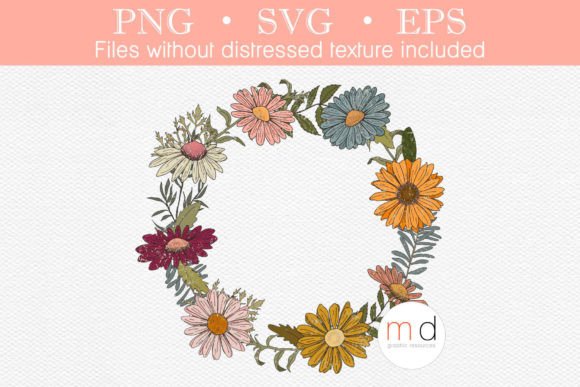
First impression? This isn’t just another floral circle—it’s a sun-drenched, slightly imperfect, warmly nostalgic wreath. The Retro Floral Wreath with Daisies lands somewhere between a 70s scrapbook page and a hand-painted café sign: loose but intentional, playful but grounded. The daisies aren’t botanically precise—they’re stylized with open centers, soft petal curves, and gentle asymmetry that reads as handmade, not algorithmic. That’s critical when you’re stitching for real people who buy handmade products because they want soul, not symmetry.
Where It Shines: Real Projects, Real Fabric
I tested Retro Floral Wreath with Daisies on a natural linen tote bag—medium-weight, lightly textured, no stretch. With a light tear-away stabilizer and 40-weight cotton thread, the design stitched cleanly at ~4.5" wide. The outer wreath shape held its flow; petals stayed distinct without bleeding into one another. It looked like something you’d find at a craft fair booth—not a stock graphic slapped onto fabric.
It also worked beautifully on a cream cotton sweatshirt (medium-heavy knit), especially when paired with a subtle tonal thread palette—ivory on ivory, oat on oat. Customers respond to that quiet confidence: it says “thoughtful,” not “trend-chasing.” For baby embroidery, I scaled it down to 3.2" and used a soft cut-away stabilizer. The simplified petal outlines read clearly even at that size—no mushy fill stitch blobs. On tea towels? Perfect. The wreath sits comfortably in the corner or centered above a monogram, adding charm without overwhelming utility.
Where to Pause—and Why
This design breathes best on stable, medium-to-heavy fabrics. On thin cotton poplin or lightweight rayon challis? I’d hesitate unless you’re using strong cut-away stabilizer *and* reducing stitch density manually. The inner daisy centers and connecting vines rely on fine satin stitch definition—those can blur or pucker if the fabric shifts under the needle.
Caps and curved surfaces are trickier. The wreath’s gentle oval shape adapts well to front-panel placement, but avoid stretching it across the crown or back curve—distortion flattens the daisies’ personality. And while it works on dark fabric, skip ultra-dense black thread on navy twill unless you’ve tested contrast first: some screen-based mockups lie about legibility after stitching.
Also note: this isn’t an appliqué design. There’s no raw-edge charm or fabric layering built in—just clean, vector-rooted embroidery file logic. If your brand leans into fabric texture or mixed-media layers, you’ll need to adapt Retro Floral Wreath with Daisies manually, not rely on out-of-the-box behavior.
Stitch Density & Detail Integrity
The fill stitch areas—especially the leaf clusters between daisies—are generous but not overbuilt. No sinking into fabric or excessive thread buildup. That means less chance of stiffness on baby onesies or pillow covers where softness matters. Running stitch outlines around petals add subtle dimension without demanding precision from lower-end machines. Still: always inspect small details before committing to a full run. One stray stitch in a petal tip can throw off the whole vibe.
What It Does for Your Craft Business
As an Etsy seller or small shop owner, Retro Floral Wreath with Daisies quietly elevates perceived value. It doesn’t scream “sale”—it invites pause. A customer scrolling past embroidered patches sees this wreath and thinks, “That’s the kind of thing my sister would hang on her kitchen wall.” That emotional resonance translates directly to trust and repeat buyers.
For personalized gifts? Pair it with a simple name or date in a clean sans-serif, placed below the wreath. The contrast between vintage floral and modern typography feels intentional—not lazy. And for boutique branding? Use it consistently across tags, packaging stamps, and social banners. Its cohesive mood supports brand recognition without locking you into one season or trend.
Practical Designer Notes Before You Stitch
- Always test on scrap fabric—same weight, same weave, same wash history as your final piece.
- Check thread color contrast in natural light *after* stitching, not just on screen.
- Review stitch density if scaling beyond ±15%—tighten fills for smaller sizes, loosen slightly for large-scale wall art.
- Confirm hoop size compatibility before digitizing adjustments—some versions may push standard 4x4 boundaries.
- Inspect small corners (like vine ends and petal tips) for skipped stitches or tension snags.
- Test black-and-white mockups to assess silhouette strength—this wreath holds up well, but verify for your specific use case.
- Compare light vs. dark backgrounds—not just for visibility, but for warmth and tone shift.
- Use appropriate stabilizer: tear-away for stable wovens, cut-away for knits, and water-soluble for delicate overlays.
- Verify licensing before selling finished items or bundling Retro Floral Wreath with Daisies into digital embroidery file packs—commercial rights vary by source.
Final Thought: It’s Not Just a Graphic—It’s a Mood Anchor
In a market flooded with hyper-polished, AI-generated florals, Retro Floral Wreath with Daisies stands out by leaning into warmth over perfection. It’s a machine embroidery design that still feels like it was sketched on a napkin at a roadside diner. Whether you’re stitching holiday embroidery for local boutiques, building design assets for your craft business, or prepping a batch of embroidered patches for a summer pop-up—this wreath delivers quiet confidence. Not flash. Not filler. Just honest, wearable, sellable boho charm.